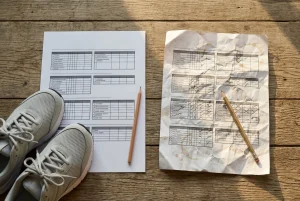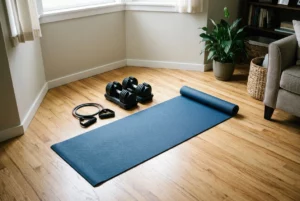

Most weight loss plans fail for ordinary reasons. They ask for an hour a day you do not have, a diet nobody could keep up, and equipment you do not own. After more than 40 years in fitness, I have come to trust a smaller set of habits that fit around a working day. I call them the Home Fitness Code, and there are five rules.
A home fitness plan for weight loss works when you can repeat it in your busiest week as well as your quietest. This article covers time, training, food, stress and coaching, in that order, and ends with a seven-day start you can begin tomorrow.
Why a simple code beats another crash plan
A crash plan front-loads effort: strict food rules, daily sessions, and a target date. That level of effort is hard to hold once work gets busy, someone in the house is ill, or you sleep badly for three nights. When the plan breaks, people tend to blame themselves, when the plan was too big for their life.
A code is short enough to remember and flexible enough to bend. Each rule below has one job, and you can apply them in any order. If you only manage two rules for the first month, you are still doing more than most people who start with a twelve-week programme and quit in week three.
For general health, UK guidance for adults is at least 150 minutes of moderate activity a week plus strength work for all the major muscle groups on at least two days. Nothing in the Code asks for more than that to begin with. If you have a medical condition, are returning after a long break, or are pregnant, speak to your GP before starting a new training routine.
Rule 1: Give training a protected 20 minutes in your working day
Twenty minutes is long enough to warm up, do a proper circuit and cool down. It is also short enough that you can fit it before a shower, at the end of a lunch break, or straight after you close the laptop.
The word that matters is “protected”. A workout that you will do “when there is time” competes with email, errands and tiredness, and it loses. A workout with a fixed slot in your diary is treated like an appointment. Choose the slot by looking at your week honestly:

- Before work: Works if you are already up early and your mornings are predictable. Lay out your clothes and your equipment the night before.
- At lunch: Works if you work from home or can step away. A 20-minute session leaves time to wash and eat.
- Straight after work: Works best if you attach it to something you already do, such as changing out of work clothes. Do not sit on the sofa first.
Pick three slots a week to start with, and write them down where you will see them. If a session gets missed, do not try to double up the next day. Move on to the next slot.
Many people stall at exactly this point. If you have started and stopped home workouts before, why home workouts fail and how to make them stick goes through the common causes and what to change.
Rule 2: Train your whole body with what you already own
You do not need a rack, a bench or a shopping basket full of kit to begin. Most people trying to lose weight are best served by training the whole body in each session, because it uses the most muscle in the least time. Think in five movement patterns:
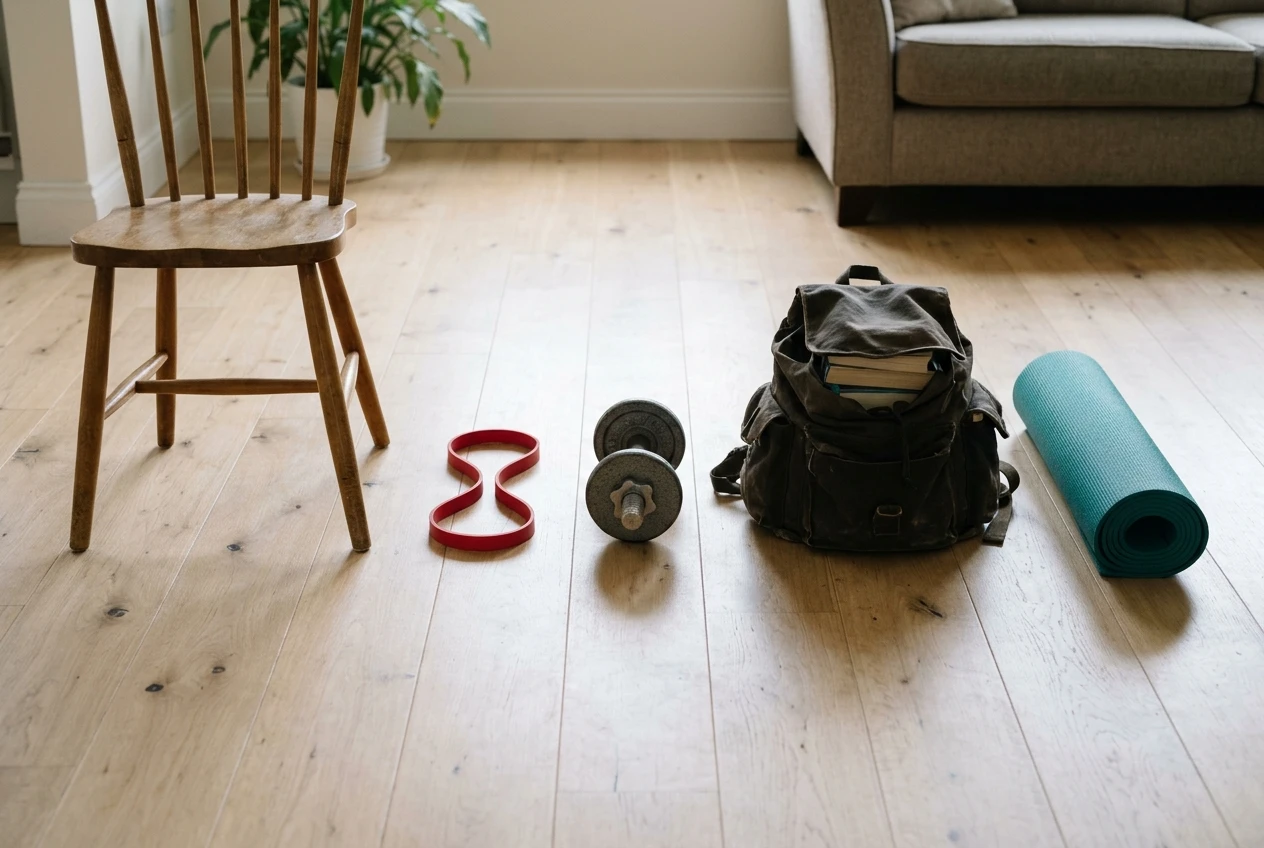
- Squat: Sit down to a chair and stand back up, or hold a weight at your chest.
- Hinge: Push your hips back with a soft knee bend, as if closing a car boot with your backside. This works the glutes and hamstrings.
- Push: Press-ups against a wall, a kitchen counter or the floor, depending on your strength.
- Pull: A row using a resistance band, a dumbbell, or a rucksack with books in it.
- Trunk: A plank on your knees or toes, or a slow dead bug on the floor.
A circuit of these five, repeated two or three times with 8 to 12 repetitions of each, fills 20 minutes comfortably. Start with a load that lets you finish each set with two or three repetitions left in the tank. Form comes before weight, always.
Progress by adding repetitions, slowing the lowering phase, adding a set, or shortening your rest. Buying more kit is only one way to make training harder, and usually the least necessary. I covered this in more detail in how to progress your home workouts without more equipment.
Muscle matters for weight loss because it keeps your body composition healthy while you eat less. Strength training also makes everyday tasks, such as carrying shopping or climbing stairs, easier, and that effect shows up long before the scales move.
Rule 3: Eat in a way you can keep up for years, not weeks
Fat loss comes from eating fewer calories than your body uses over time. Exercise helps, but a 20-minute session burns a modest amount of energy, and it is easy to eat that back without noticing. This is why a home fitness plan for weight loss needs a food approach that you can live with, alongside the training.
Rather than banning foods, start with a few additions and swaps:
- Protein at each meal. Eggs, fish, chicken, yoghurt, beans, lentils, tofu or lean meat help you feel full and support muscle while you lose weight.
- Vegetables on half the plate at your main meals. They add volume and fibre for few calories.
- Plan your snacks. Most overeating happens when you are hungry and nothing is prepared. Decide what you will have mid-afternoon before the afternoon arrives.
- Watch liquid calories. Sweetened drinks, large coffees with syrup and alcohol add up quickly and do little for fullness.
- Keep portions of treats in the house, not the whole packet. You do not have to give them up.
A sensible rate of loss is gradual. Aiming for about half a kilo to one kilo a week is the figure commonly given in UK health guidance, and slower is fine. If a plan promises much more than that, be suspicious of it.
The test for any eating approach is whether you could still follow it in a year. If it needs you to weigh every gram, skip every family meal or feel hungry all day, it is a short-term fix. Small changes that you keep will outperform a perfect plan that you drop.
People with diabetes, a history of eating disorders, or other medical conditions should get personal advice from a GP or registered dietitian before changing how they eat.
Rule 4: Use movement to take the edge off stress and sleep better, and know its limits
Work stress often shows up as a tight neck, a busy head in the evening, and poor sleep. Physical activity can help with all three. Many people find a short session clears their head and lifts their mood, and regular activity is linked with better sleep and a better outlook over time.
You can use the Code to deliberately target this:

- Schedule a session on your most stressful day, not just on the easy ones. Twenty minutes of effort gives your mind something else to attend to.
- Add a 10 to 20 minute walk outside on days you do not lift. Daylight in the morning also helps your body clock.
- Finish hard training at least a couple of hours before bed if you find it keeps you awake. Gentle stretching or an easy walk is better late in the evening.
- Breathe slowly in your cool-down. A minute of long, slow exhales brings your heart rate down and marks the end of the session.
Movement has limits, and it is worth being clear about them. Exercise is not a treatment for clinical depression, an anxiety disorder or chronic insomnia. If low mood, constant worry or poor sleep has lasted more than a couple of weeks, or is affecting your work and relationships, talk to your GP. Training can sit alongside professional help and often supports it, but it should not replace it.
Over-training is another risk. Hard sessions on top of poor sleep and a heavy workload can leave you more drained rather than less. If you feel flat, sore for days or irritable, take an extra rest day. Recovery is part of the plan.
For wider habits that keep you well in a busy life, see staying healthy when modern life isn’t built for it.
Rule 5: Let a coach adapt the plan to you, and where FitForge fits
A generic plan treats everyone the same. A good coach asks about your injuries, your schedule, your equipment and your experience, then adjusts the programme as you progress. That adjustment is the personalisation, and it is why people who work with a coach often stay consistent for longer.
A human coach is one route, and a good one if you can afford it. Many people cannot, or do not want to book sessions around a changing work diary. AI coaching is another option, and FitForge is one I would point you to if you want to try it. It is one choice among several, and you do not need it to follow the Code. The five rules work with a printed plan, a notebook and a stopwatch.
Whichever route you take, judge it by what it asks and how it responds:
- Does it ask about injuries, pain and medical history before giving you exercises?
- Does it take your available time and equipment into account?
- Can it change the plan when you miss a week or feel run down?
- Does it explain why it is progressing you, and let you say no?
I wrote a full checklist for this in what a good AI strength coach should ask you before building your plan. Read it before you commit to any coaching tool, FitForge included, and treat the questions as a standard it has to meet.
An AI coach cannot see your form, take your pulse or know how you feel unless you tell it. If an exercise hurts, stop and get it checked. Use any coaching tool as a guide that you keep in charge of.
Your first seven days with the Home Fitness Code
Here is a simple week that uses all five rules. Adjust the days to suit your diary, but keep the shape.
Day 1: Set up. Pick three 20-minute slots for the week and put them in your calendar. Clear a patch of floor, find a chair, and gather whatever you have: a resistance band, a pair of dumbbells, a rucksack you can load with books. Write down what you usually eat on a working day, without judging it.
Day 2: Session one. Spend three minutes warming up with marching on the spot, arm circles and bodyweight squats. Then do your five-pattern circuit (squat, hinge, push, pull, trunk) for two rounds. Finish with three minutes of stretching and slow breathing.
Day 3: Walk. Take 15 to 20 minutes outside, ideally in daylight. Add one protein-rich food to each meal today.
Day 4: Session two. Repeat the circuit. Try for one extra repetition on each exercise, or a third round if the first two felt comfortable.
Day 5: Rest and prepare. No training. Plan two or three dinners for the coming week, and decide what your afternoon snack will be.
Day 6: Session three. Do the circuit again. Notice which exercise felt hardest and which felt easiest, and make a note of both.
Day 7: Review. Ask yourself four questions. How many of the three sessions did I complete? How did I sleep? How was my mood on training days compared with rest days? What got in the way? Adjust one thing for next week, and only one.
Your weight may not change in the first week, and that is normal. What you are building is a pattern. Once it holds, the 4-week beginner dumbbell plan gives you a structured next step.
Questions to ask before you start training at home
Ask these before you begin, and answer them honestly. They save you from a plan that does not fit.
- Do I have a health condition, injury or medication that affects exercise? If yes, see your GP first.
- When, specifically, will I train this week? A day and a time, not “sometime”.
- Where will I train? You need a clear space about the size of a yoga mat, plus a place to keep your kit visible.
- What equipment do I already have? Use that first, and only buy more when the lack of it is clearly holding you back.
- What will I eat on the days I train? Do you have protein and enough food in the house to avoid the takeaway at 7pm?
- How will I know it is working? Choose more than the scales: energy, sleep, how clothes fit, or how many repetitions you can do.
- What will I do when I miss a session? Decide now. The answer should be “do the next one”, not “start again on Monday”.
- Do I want a coach? If yes, will it be a person, an app, or an AI option like FitForge, and does it ask the right questions?
Answering these takes ten minutes and tells you far more about your chances than any motivational plan.
Start with Rule 1 today
The Code works because each rule is small enough to do. You do not need to master all five at once. Book the time, use what you have, eat in a way you can repeat, move to manage stress, and get the plan adapted to you as you go.
Take a look at the FitForge official page to see whether its AI coaching suits your week, then start with Rule 1 today and book your first 20 minutes.